
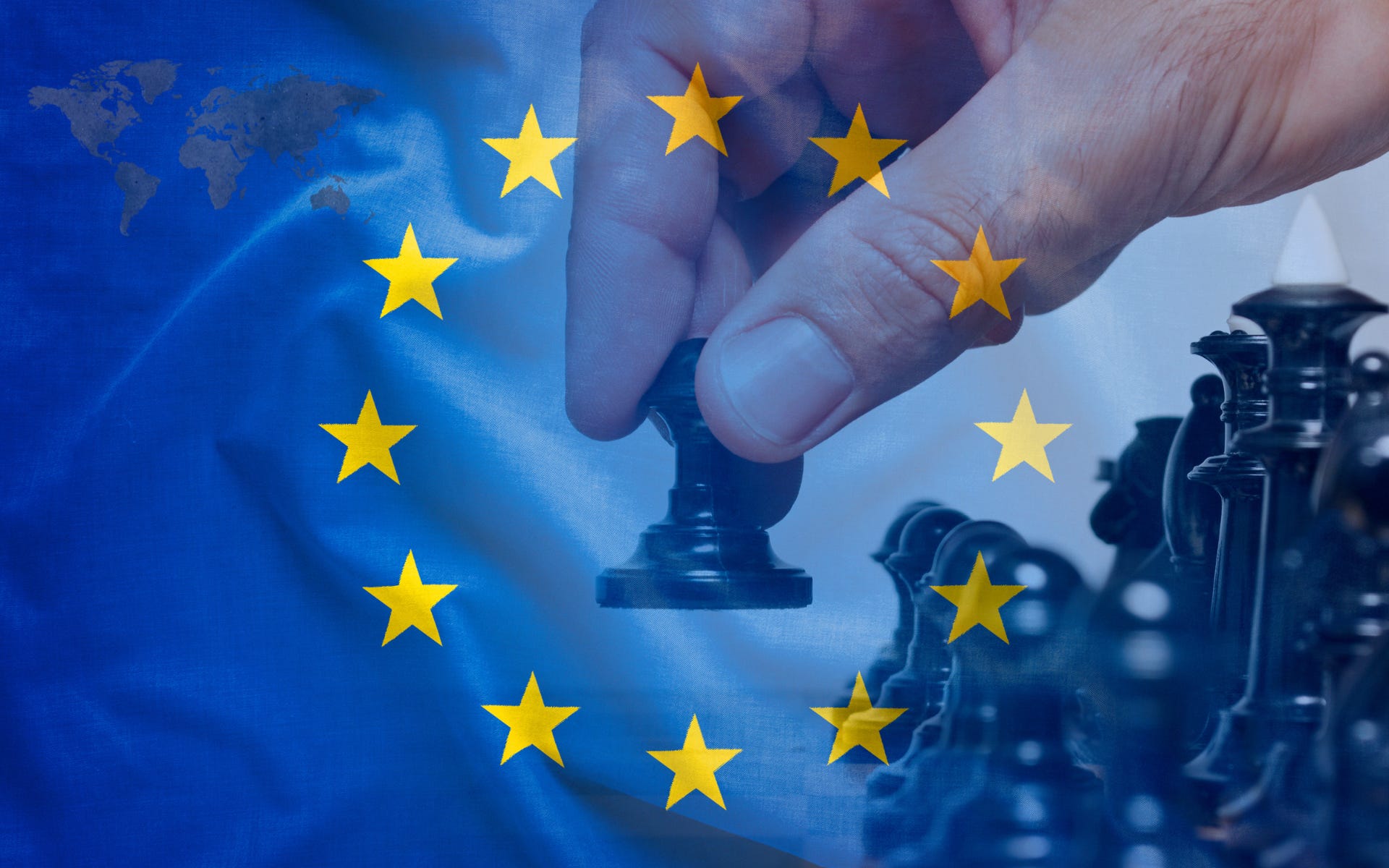
The E.U.'s Worldview
Two broad approaches the E.U could take in its foreign policy
E.U. Sets Out Its Worldview
We are living in an “era of hyper-competitive and hyper-transactional geopolitics. Gone is the world of hyper-globalisation and ever more cooperation. These days the international environment looks stark and even dark where “countries are weaponising their sources of strength against each other.” That was the view this week of the EU Commission President, Ursula von der Leyen, as she outlined a “more direct and focused foreign policy” at a gathering of EU ambassadors in Brussels.
Here is a little more of what she said about the world the E.U. perceives today:
“This is a world where we can no longer take much for granted – including the rules and norms that were built over the past 70 years. A world in which major powers try to eke out any possible advantage using whatever tool works best – whether it be economic, technological or security tools. Sometimes all three at the same time. A world in which there is now a concerted attempt to build spheres of influence – and even grab land – much like in the 19th century or at the height of the Cold War. A world in which new authoritarian powers are clubbing together with a rogue Russia – ready to pounce on any division or weaknesses in alliances. A world in which emerging powers have become disillusioned with the way the international system works – and are increasingly looking for alternatives. In most cases, they will work with whoever puts the best offer on the table.”
The E.U. could take two broad approaches in its foreign policy, focusing on how the world ought to be or deal with the world as it is. Given the world that the Commission President has described, it is no wonder that the E.U. has chosen to “deal with the world as we find it.” She said that it will do so while staying “true to who we are and what we believe in.” The E.U. is focusing on what it can control, and navigating what it can’t.
Europe has several key international challenges to deal with. In its neighborhood, Russia’s invasion of Ukraine (an EU candidate country) remains ongoing. The E.U. and its member states have already supported the country amounting to EUR 134 billion, “more than anyone else”, and the E.U. has said it is committed to Ukraine for as long as it takes as it seeks to deter possible further Russian expansion. However, Ukraine cannot depend on the E.U. alone and needs American support. European defense is still too dependent on its closest friend and NATO ally, the United States. However, the recent US elections have just returned a Euroskeptic to the White House whose leadership style takes a more transactional approach to long-term allies.
It’s been a busy two weeks for President Trump since his inauguration. Rather than the traditional reaffirming of his nation’s ironclad commitment to the NATO alliance, he instead wants the United States to purchase Greenland from Denmark for its defence. At a press conference earlier this year he seemed to question Denmark's sovereignty over the territory and would not rule out using force against its NATO ally in that pursuit. He has also indicated that he would erect trade tariffs on the E.U. in a similar approach that he has taken towards U.S. neighbours in Canada and Mexico. As discussed recently in this newsletter, the U.S. president seems inspired by the late 19th century President McKinley known for expansion and tariffs. That 19th-century approach now seems to rank higher in the White House than the close cooperation that emerged with the Europeans during the Cold War during the 20th century. Meanwhile, in the 21st century, the world is more connected than ever, yet Trump’s approach has left Europeans questioning the reliability of their transatlantic partner.
In dealing with the world as it is, the E.U. is thus prioritizing pragmatism over idealism. It’s a realist world now and there is a real sense that the E.U. is rationally reevaluating its foreign policy approach, prepared to tweak and pivot where necessary to preserve its long-term self-interest in the international system.
We got a sense of that this week. In relation to the transatlantic relationship, the Commission President stressed that the European Union wants to continue its close relationship with the United States if aligned with its interests, saying that “we want to make it work. And not only because of our historic ties but because it is simply smart business.” However, the E.U. is also seeking to reduce its dependence on the U.S. and take a more agile approach to its international relations. It is also stepping up its investment in defence. This week leaders of the member states gathered in Brussels for a retreat for discussions focused on three main defence topics: capabilities, funding, and partnerships.
In recent months the E.U. concluded new trade partnerships with Mercosur, Mexico, and Switzerland, and is restarting negotiations with Malaysia. The E.U. is also willing to “work with countries that are not like-minded but do share some of our interests, the Commission President said.” Such an approach includes China. In recent years the EU has sought to de-risk but not de-couple from China, however, President von der Leyen told the EU ambassadors this week that:
“there is also room to engage constructively with China – and find solutions in our mutual interest…I think we can find agreements that could even expand our trade and investment ties. It is a fine line that we need to walk. But it can lead us to a fairer and more balanced relationship with one of the world's economic giants. And that can make sense for Europe.”
The European Commission is responsible for trade policy and coordinates foreign policy at the EU level; however, many aspects of foreign policy remain under the control of the 27 individual member states, which retain significant autonomy in this area. So, it was significant to also hear from Antonio Costa, President of the European Council, which represents the member states. He painted a similar worldview
“of fragmentation and polarisation. Of disorder and complexity. A world in which power politics have made a comeback.”
However, he also pointed out that in this world there are also opportunities. With the UK Prime Minister, Sir Keir Starmer, in Brussels this week, Council President Costa spoke of the “new positive energy” with the United Kingdom and “a new momentum for enlargement” of candidate states. He described the U.S. as “our friend, our ally and our partner” and said that “the European Union and the United States together have been pillars of the rules-based order”, however, given President Trump’s recent statements regarding the Danish territory of Greenland, Council President Costa also stressed that:
“The European Union will stand for this universal respect of international law and the rules-based order anywhere. In Ukraine, in the Middle East, in Africa and of course also in the Kingdom of Denmark. All the more – obviously – if the territorial integrity of a member state of the European Union is questioned.”
The coming weeks and months are going to be interesting in transatlantic affairs.


