


In this edition: signal; system insights; what I am reading; and one last thing.
Signal
Washington and Beijing Could Move Toward AI Diplomacy Amid Strategic Decoupling
The United States and China are reportedly considering formal talks on artificial intelligence ahead of a planned Trump–Xi summit in Beijing next week, according to the Wall Street Journal.
The discussions would take place against a backdrop of export controls, semiconductor restrictions, rare-earth negotiations, and broader geopolitical competition.
The U.S. continues tightening controls on advanced AI chips, and China is accelerating efforts to build technological self-sufficiency.
Background Details:
Washington wants greater access to Chinese rare earth minerals and strategic industrial inputs.
Beijing wants relief from U.S. semiconductor export controls.
AI discussions could become institutionalised as part of broader US–China strategic management.
Taiwan remains a central flashpoint in negotiations.
Major powers such as the United States and China are increasingly treating semiconductors, energy grids, and rare earths as geopolitical assets rather than purely commercial sectors.
Chinese state-owned media recently highlighted how the two countries working together could help both nations overcome energy bottlenecks that threaten global AI development.
Former US President Biden had previously engaged with Chinese President Xi on AI at a summit in California in 2023, and both sides subsequently announced in 2024 that humans, rather than AI, would retain authority over nuclear-launch decisions.
Sources: WSJ Reuters China Daily
On the Radar
EU Scrambles to Contain Latest Transatlantic Trade Rupture
After US President Trump threatened to raise tariffs on EU cars and trucks from 15% to 25%, negotiators from both sides met in Europe this week to defuse the escalation.
The EU and the US struck a framework trade agreement at a summit in Turnberry, Scotland, last summer.
Still, since then, a US Supreme Court ruling has introduced fresh uncertainty around the tariff framework, and the European Parliament has slowed the ratification process.
The US side has become dissatisfied with the pace of European ratification. European leaders and lawmakers stress procedural legitimacy and robust safeguards.
However, after talks this week and reports of some progress, US negotiators, MEPs and the EU member-states failed to reach an agreement. They have, however, agreed to meet again after more than 6 hours of talks on Wednesday.
Sources: WSJ Euronews Politico EU Commission
System Insights
US-China Summit: Rather than just another technology race, AI is fast becoming an infrastructure for geopolitical power. Governments increasingly view advanced AI capabilities as strategic assets, much as earlier generations viewed oil, naval power, or nuclear technology, because they are tied directly to national security, industrial competitiveness, and military capability.
Just as important, the scale and uncertainty of AI’s future capabilities mean that the world’s two largest economies, and geopolitical rivals, should ideally cooperate on shared risks. Businesses now operate in a world where technology supply chains are shaped by diplomacy, sanctions, and strategic rivalry.
EU-US Trade: The EU-US trade relationship is among the most significant in the world, with over €4.2 billion of goods and services crossing the Atlantic every day, according to EU estimates. Trade is now clearly being used as leverage inside the transatlantic alliance rather than just as a commercial tool. Europe may have thought it had a settled agreement with the US administration that restored stability and predictability, setting a US tariff ceiling of 15% for most EU exports, but now that the US is already looking to renegotiate terms, some European politicians are wondering how reliable an agreement with the current administration can be.
Finding a balanced deal is difficult because the underlying rationale of an “America First” policy approach means that, from the Trump administration’s point of view, Europe must come at least second. Zero-sum relative gains trump a mutually beneficial outcome in this American administration’s approach towards its long-time European allies. Europe seemed to accept that reality last summer as the current price to pay for access to the US market (because alternatives could have been worse) when the EU Commission President Ursula von der Leyen signed the trade agreement with the US. Now they find themselves scrambling again to contain the latest transatlantic trade rupture.
For European businesses, the latest US tariff threats are especially sensitive (particularly in Germany), because autos sit at the centre of industrial employment, supplier networks, and regional politics. The US is the second largest market for new EU vehicle exports (after the UK), accounting for 18.4% of the EU export market in 2025, according to ACEA, the European Automobile Manufacturers’ Association. Yet again, European executives find themselves reviewing their exposure to US sales, tariff pass-through, pricing power, and deciding on the relative value of investing in localised production to further growth prospects in the US economy in the short to medium-term.
What I am Reading
US-China Relationship. Ahead of the summit between US President Trump and Chinese President Xi Jinping in Beijing next week, Thomas Friedman argues in The New York Times this week that the U.S. and China now face a shared, non‑state threat more dangerous than their geopolitical rivalry from agentic AI systems capable of enabling small actors to launch catastrophic cyberattacks. Washington and Beijing must cooperate because “our fates are now fused”. Opinion | The U.S. and China Have a Common Foe. Hint: It’s Not the U.S.S.R. - The New York Times
US-German Relationship. Jörg Lau argues in The Guardian this week that Friedrich Merz’s confrontation with Donald Trump marks a historic break in the German‑US relationship, but one year on from his election as Chancellor, Merz is choosing not to back down because he sees the status quo as unsustainable. Why Friedrich Merz decided to risk Donald Trump’s wrath | Jörg Lau | The Guardian
Transatlantic Security Order. Jackson Janes and Markus Ziener, both senior fellows at the German Marshall Fund, argue in Just Security that the post-1945 transatlantic security order, in which Europe integrated internally while relying on unconditional American protection, is over. Europe must pay the “subscription” to the US for now while it urgently rebuilds its strategic capacity and reforms its decision-making structures. The Unraveling of the North Atlantic Bargain
One Last Thing
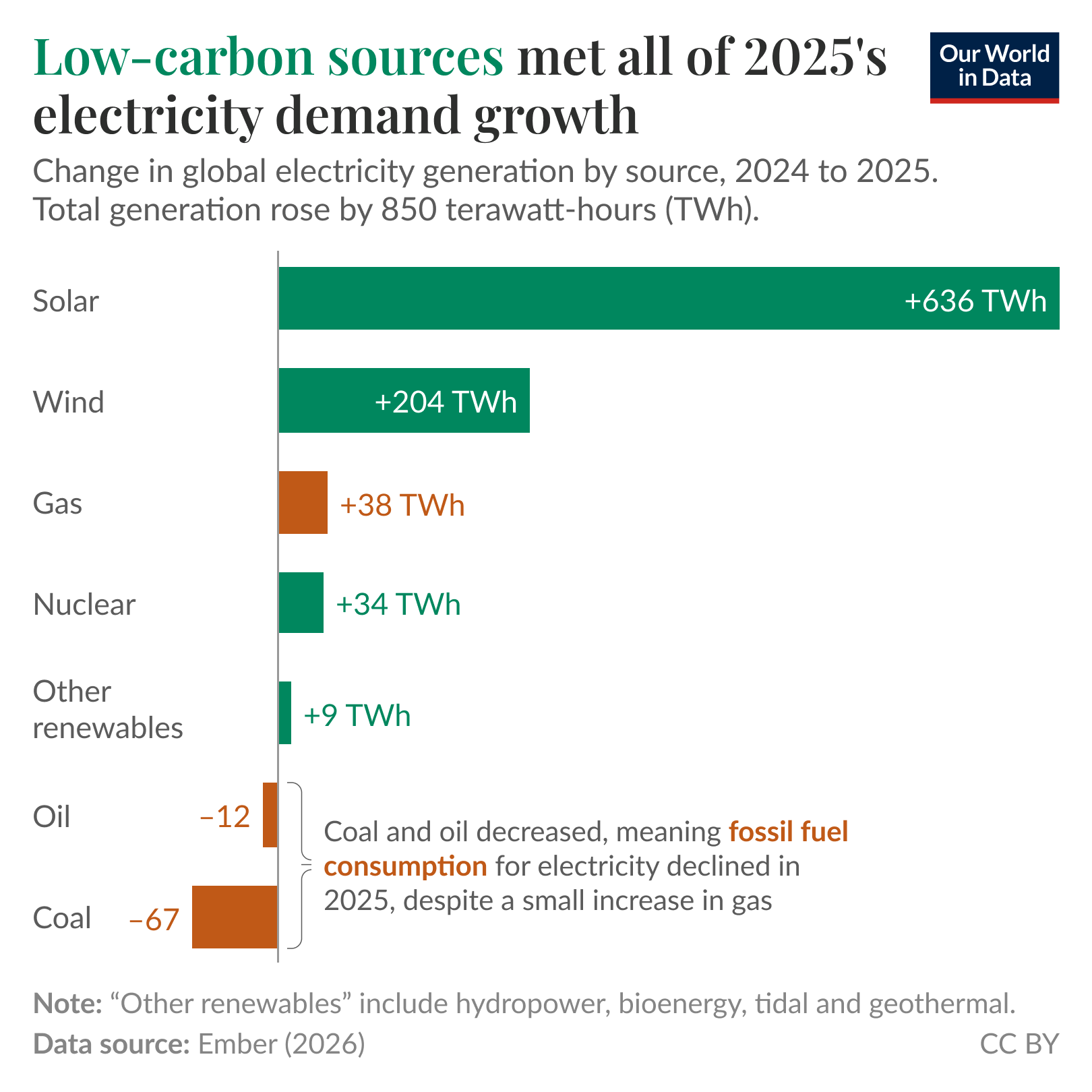
Low-Carbon Electricity. Against a backdrop of renewed concern over fossil-fuel supply disruption in the Middle East, and away from the headlines, a quieter shift is underway.
This week, Our World in Data highlighted a 2025 milestone: low-carbon electricity sources grew faster than demand, and fossil generation fell overall. Based on Ember’s Global Electricity Review 2026, the analysis notes that solar and wind drove most of the growth, while a small rise in gas was more than offset by declines in coal and oil.
As always, thoughts shared here are intended for discussion and knowledge only, not financial, investment, or legal advice. Always chat with your advisors first.