


Europe faces a significant challenge: the old continent’s population is aging and shrinking. Europe has one of the oldest populations globally, with low birth rates and a high average life expectancy. This trend is expected to continue. This demographic shift has far-reaching consequences for both the political landscape and the European Union’s economy. Here's a breakdown of what the entangled triangle of demographics, economics, and politics could mean for Europe's future.
Why is this important?
Demographics, politics, and the economy all interact with one another. A change in one part of this entangled triangle impacts the other sides. Demographic shifts have a significant influence on economic growth, the labour market, defence capability, and government budgets. Demographic trends in Europe can also influence political agendas, which influence the allocation of resources. This is becoming especially important as regionalisation trends alongside globalisation, making local answers to local problems more prominent.
A shrinking population means a shrinking workforce. Fewer workers in the economy can impact productivity, reduce consumption, and see businesses and providers of public goods and services throughout Europe struggle to fill vacancies for much-needed qualified workers in sectors targeted for growth, particularly at a time when the European Union is seeking to reindustrialise, enhance its homegrown security capabilities, transition to a green economy, and become more competitive in the global economy.
The EU needs a lot of investment in the years to come to fulfill its ambitions in multiple areas, but demographic trends run counter to those ambitions. An aging population across the continent means that an increasing number of workers will reach retirement age and have different life needs from things such as private housing to public services. They will also require pensions and more healthcare services.
While the prospects of a bigger silver economy have their own benefits, still, governments will increasingly face pressure on their national social security systems, which may mean higher taxes or cuts in spending to balance national accounts. Furthermore, as Europe greys, many aging workers will also start to draw from their private savings, investments, and pensions, which means less new money available to invest in the economy.
A smaller workforce, less private investment, less consumption, smaller income tax revenue, and higher public spending costs are a recipe for dampened economic growth and hindered innovation, particularly when several member states, such as France, Italy, and Greece, already struggle with high levels of public debt.
Politically, an aging European population should be expected to vote for parties and public policies closer to their preferences, which likely requires more public spending on public goods such as healthcare. Spending in these areas may necessitate spending cuts or tax rises elsewhere, potentially leading to social unrest by younger generations and a new round of populist politics.
Absent, public policies that encourage Europeans to have more babies, that support childcare, or encourage longer working lives, political leaders in search of higher economic growth may have to look towards more targeted workplace automation or increased immigration of skilled workers to increase productivity and competitiveness.
EU-level solutions may become necessary, requiring more policy competencies to be transferred to Brussels from the 27 member states. That may require changes to EU treaties and referendums in several member states. Such policies that priortise robots over humans, more immigration, and more centralised political decision-making in Brussels, could (depending on how they are approached) prove politically divisive, polarizing political opinion, stalling political decision-making, and further hampering economic growth.
What is happening now?
The median age in the world in 2023 was 30.5 years, and in Europe it was 42.2 years. Europeans are also living longer. Life expectancy, globally, for both sexes was 73.4 years in 2023; in Europe, it is 79.5 years.
However, Europe’s old are not being replaced in sufficient numbers with newborn European babies. The global total fertility rate (live births per woman) in 2023 was 2.3, while in Europe, it was 1.5, below the critical replacement threshold (a value below 2.1 will cause the native population to decline).
According to the latest available information from Eurostat, the statistical agency of the European Union, the overall EU population is set to follow a trajectory of decline for the rest of this century. The elderly (those 65 years and over) account for the only main demographic age group projected to grow in this period.
The share of the working-age population (15-64 years old), of most significance for economic growth, is projected to decrease from 285.5 million (63.9 % of the population) at the beginning of 2022 to 228.1 million (54.4 %) by 2100. This would represent an overall reduction of 57.4 million. The sharpest decline in this age cohort is projected to arrive in the coming years, declining to 60% of the EU population by 2038.
Meanwhile, the proportion of elderly people in the EU is projected to increase from 94.3 million (21.1 % of the population) at the beginning of 2022 to 136.1 million (32.5 %) by the century's end. That projected rise of 11.4% corresponds to 41.8 million more older people, not of working age, by 2100.
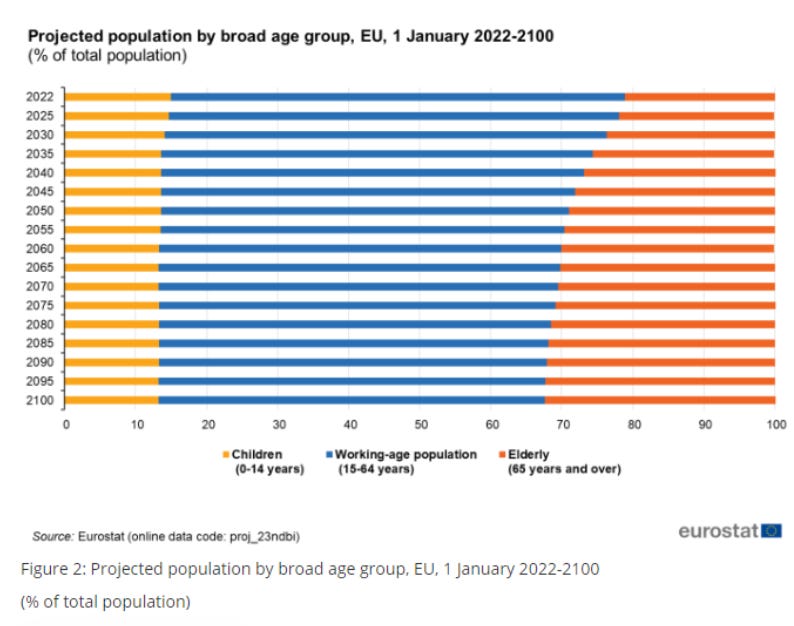
Source: Eurostat (proj_23np)
Overall, it is projected that the EU population will peak at 453.3 million in 2026 (+1.5 %), before decreasing to 419.5 million in 2100. That would be an overall decrease of 27.3 million (-6.1 %) from 2022 to 2100. However, these numbers are based on several assumptions, including projected net migration numbers in member states in the years ahead.
EU population changes over time are a function of births, deaths, and net migration. In many EU member states, more people are expected to die than be born in the coming decades. To mitigate steeper drops in population numbers, net migration is expected to pick up much of the slack. For example, Germany, the largest EU member-state, is projected to see its population naturally decline by over 20 million over this period and fill the large gap with cumulative net migration flows.
There is a similar phenomenon projected for France. Meanwhile, Italy, even with a projected cumulative net migration of nearly 19 million over the period, could still see its population decline by about 9 million by 2100. Looking at the picture for all EU member states (and the three EFTA countries), it goes without saying that Europe's population would be a lot smaller in the years to come without the effect of net migration.
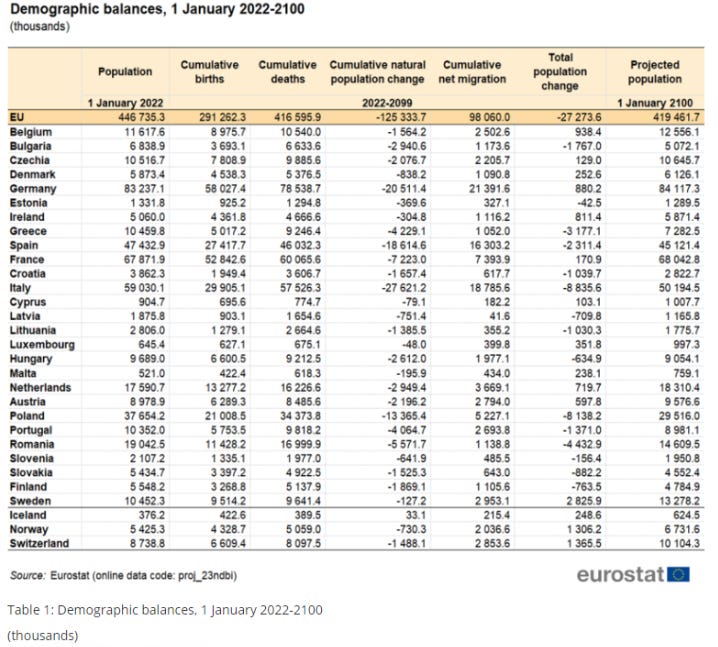
Source: Eurostat (proj_23ndbi)
Policymakers must adapt to changing circumstances, and factors such as geopolitical events, economic conditions, and humanitarian crises can influence migration patterns. However, it is also true that political ideology and voter preferences are also influential. Ahead of European elections this June, there is a rise in public support for populist radical right-wing parties across the EU that argue for very restrictive immigration policies. In the current context, it is reasonable to project that European politics will move further to the right in the coming years if these parties increase both their influence and vote share and become part of the political decision-making process.