
The E.U. Needs to Get Out of its Own Way...and Bond Together
The E.U. has a new College of Commissioners, but storms are gathering
This week, the returning President of the European Commission, Ursula von der Leyen, announced the composition and structure of the next College of Commissioners and the roles the newly appointed commissioner candidates will perform in Brussels over the next five years. The commissioner candidates who have been put forward by their home member state governments will now undergo confirmation hearings in the European Parliament in the coming weeks and, if successful, will take up office before the end of the year.

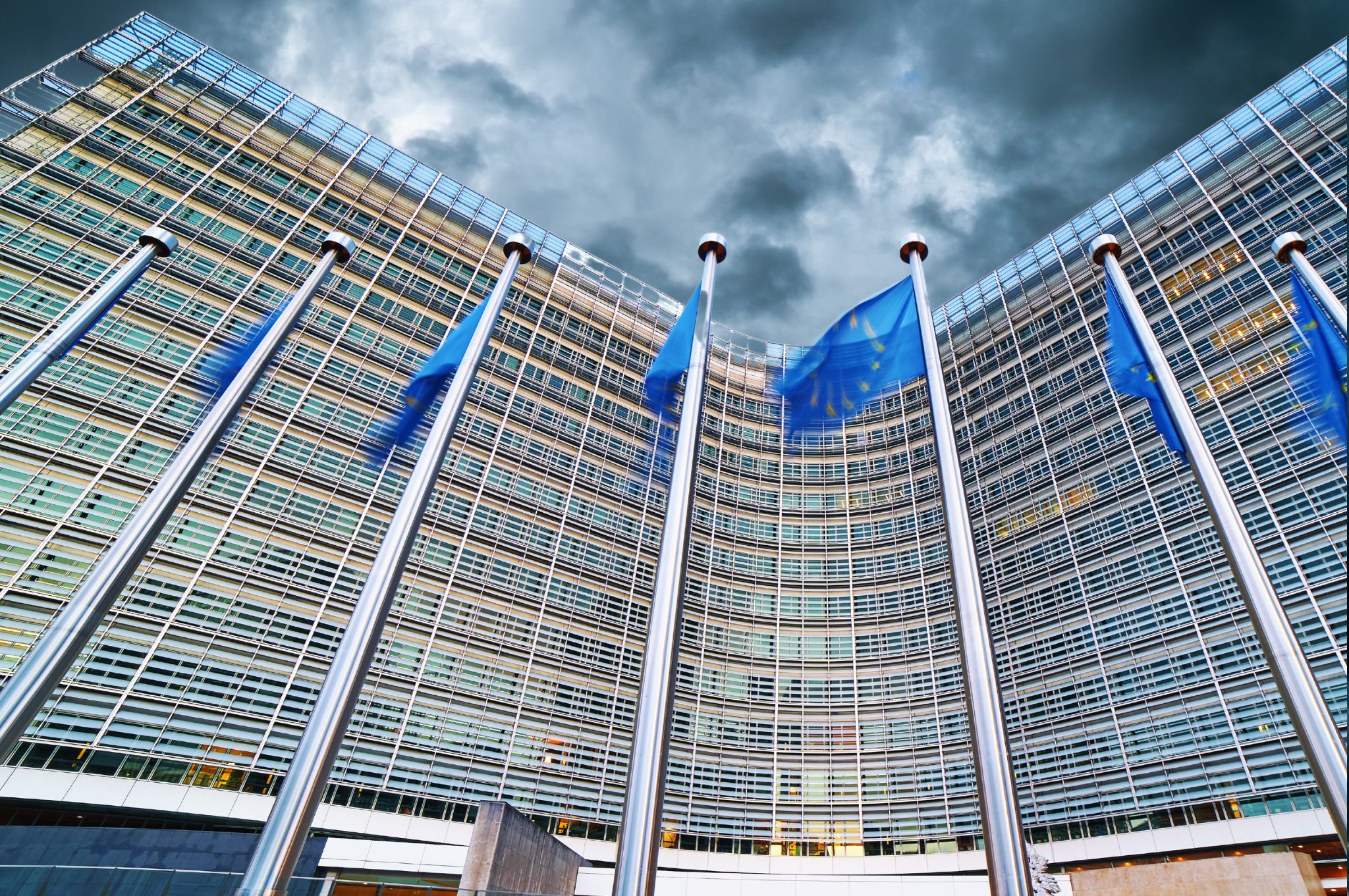
The Commission is the executive branch of the E.U. and plays an essential role in governance and proposing new policies. The newly appointed commissioners will lead that role over the next five years across multiple policy areas where the E.U. has competence, including trade, clean economic growth, and competition policy. An interesting development for the incoming college is the decision to create a new policy portfolio focused on defence and space (defence remains mostly a competency of the member states, however, the E.U. is slowly increasing its involvement in this area, primarily through coordination and funding initiatives). The commissioners will take office at a time when dark clouds are gathering over the continent. The European Union faces big challenges and threats that if left unaddressed in the coming years, could impact the EU’s place in the world or even prove existential.
The era of geopolitical stability and rapid world trade growth that has benefited the E.U. over the last decades is fading as wars and trade conflicts have undermined the principles of the rules-based international order. These were the foundations on which the E.U. had previously built its success.
Today international power politics is more often driving economics but the E.U. needs to be more united to navigate this new landscape. Furthermore, the E.U. has lost competitiveness, its economic capabilities are not at par with global competitors. It has not been a significant player in the digital revolution which has transformed the global economy, for example only four European companies rank among the top 50 global tech companies. This has largely contributed to the widening gap in GDP between the E.U. and the U.S. In the early 1990s, both the U.S. economy and the E.U. single market were of a similar size. Since then, the U.S. economy has grown roughly twice as fast as the EU single market.
The continent also faces a demographic problem, as Europeans increasingly grey and grow old it is estimated that the workforce will shrink by close to 2 million jobs per year by 2040. That is sure to impact productivity. If Europeans don’t start having more babies, then the obvious answer would be to allow more immigration to make up the gap. However, this does not seem politically feasible in the current climate as anti-immigration national populist parties continue to enjoy influence in political discourse and success at the ballot box across Europe, particularly in the largest member states Germany, France, and Italy. Just this week this anti-immigrant sentiment saw Germany reintroduce checks at its Schengen borders. If increased immigration remains off the agenda then the E.U. will need to lean more toward finding efficiencies such as those offered through technological innovation.
Security is also a more recent, and unexpected, major concern for the union as war continues to rage in neighbouring Ukraine. The peace dividend that followed the end of the Cold War now seems to have dried up. Eastern E.U. member states that border Ukraine and Russia feel particularly threatened. It should come as little surprise that the next High Representative of the Union for Foreign Affairs and Security Policy comes from the East. A key concern is the E.U.’s ability to defend itself following years of under-investment in its collective defence capabilities and the lack of an appropriate-sized European defence industry to support relative continental self-sufficiency.
All of this means our living standards, way of life, and security are threatened in a way that has not existed for decades. Whole generations of Europeans, including my own, who were born and grew up European have never known such a time. These challenges have crept up on us when we were busy making other plans. We have lived in a world where the social market economy could more easily be prioritized because Russia supplied the cheap energy to power many European factories and homes, China opened up its huge market for European businesses, and much of the continent felt secure because they could unquestionably depend on American allies to unequivocally underwrite most of our continent’s physical security.
Moreover, there was no urgency to create our own version of Silicon Valley in Europe because our close ally, the United States exported almost everything that we needed. What we could not get from America we could get from Asia or elsewhere such as critical raw materials and essential components. Many in Europe saw the U.S. and the E.U. as two sides of the same coin. Before the Donald Trump presidency, very few foresaw the possibility that America’s commitment and interest in European security and values could perhaps one day no longer be assured. Those days of stability were good when they lasted, but they are coming to an end. Europe once enjoyed a period of stability, but that is now under threat. It had found its sweet spot but it is now turning sour. It cannot remain overly dependent on the outcome of U.S. elections where the result could now go either way for European interests. If we as Europeans don’t take action soon we may fall further behind and no longer retain the ability to keep our freedom and destiny in our own hands. The challenge for the next E.U. commission will be to ensure that Europe can take care of its own, and on its own if it is ever forced to do so.
The European institutions and member states already had the foresight to recognise these growing problems. They commissioned two reports prepared by two former Italian Prime Ministers to provide a road map forward. Both reports have addressed the many challenges outlined above.
The first report, the Letta report, prepared by Enrico Letta and published in April this year concerned rejuvenating the three-decades-old EU Single Market with proposals to widen and deepen its functioning, enabling it to be better configured for the future. The second report, published just this September by Mario Draghi addressed the future of European competitiveness by seeking to lay out a new industrial strategy for Europe.
In reading the problem areas Draghi’s report addresses, it seems obvious that Europe should get out of its own way and bond together. Part of Europe's problem is that member states often do their own thing and when they do articulate common objectives they then lack the focus to avoid waste of common resources or lack coordination when it matters most. Legislative decision-making at the E.U. level can take, on average, up to 19 months and that’s even before these new laws are adopted at the member-state level. Moreover, over-regulation often hamper Europe's own emerging enterprises from growing.
The report suggests three areas to rejuvenate sustainable growth: closing the innovation gap with the U.S. and China, linking decarbonization goals with increasing competitiveness, and thirdly, an EU “foreign economic policy” to increase security and decrease dependences. To achieve these objectives the report suggests that Europe needs a level of investment larger than the Marshall Plan. Investment needs to rise to 5% of GDP. The report supports the advance of the Capital Markets Union but believes that the private sector will not be able to do all of the heavy lifting without public sector support. Member states will have to bond together by jointly funding investment in key European public goods, such as breakthrough innovation. However, joint funding is a prospect that is likely to meet resistance from member states in the frugal north which have been traditionally cold on such initiatives.
In announcing the new commissioner candidates this week, E.U. Commission President von der Leyen said that the new mandates' core priorities would be built around prosperity, security, and democracy. The backdrop is competitiveness - one of the main recommendations of the Draghi report. Both Letta’s and Draghi’s reports can act as blueprints to help the European Union get out its competitive rut and ensure its significant place in the world. Now that the patient has been assessed and diagnosed it will be up to the leadership abilities of EU politicians and the governments of the member states to provide the treatment and care the E.U. will need over the next five years.


