

The Politics – Markets Nexus
The hidden system driving markets and how to navigate it

Many of us who are involved in supply chain decisions, or invest in businesses that do, will no doubt have been paying attention to the Strait of Hormuz crisis currently underway amid the US/Israel-Iran war in the Middle East, which has played havoc with oil and gas prices in the market and delivery times for businesses, since it broke out in late February. Blockages are a major problem because, these days, roughly one-fifth of the world’s oil flows through this region.
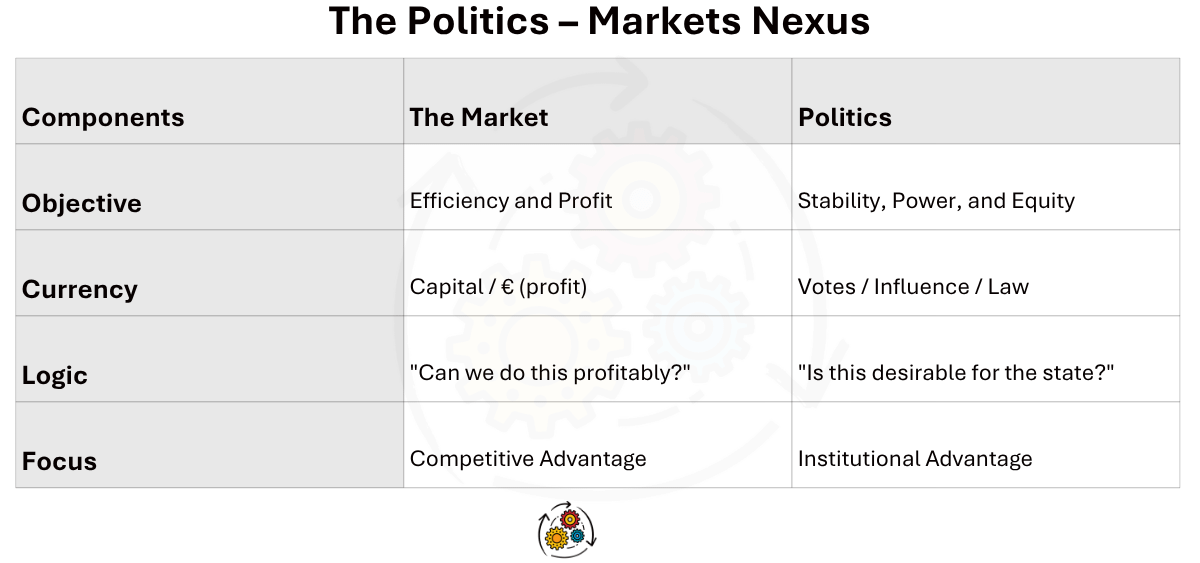
When we talk about the “market,” such as the stock market, it can often feel like we are speaking about an independent natural force, as if we were talking about the weather or gravity. However, as the events in the Middle East continue to unfold, it becomes more obvious that when we look at the market through a political economy lens, what we are really dealing with here is the politics–markets nexus, a system shaped by different social constructs and changing power dynamics.
Markets and the political economy are structurally interdependent:
Markets are what we see most clearly because they provide the mechanism for exchange. But business training has led many of us to expect that economic efficiency, open markets, and institutional authority are still the order of the day.
However, it is the power plays, laws, and norms within the political economy that provide the “operating system” that enables those market exchanges.
Together, the marketplace and the wider political economy form a sort of co-evolutionary loop within a single complex adaptive system.
Observable system dynamics amplify this interplay. For example, market success generates wealth, which the financial winners often deploy to lobby politicians toward their preferred market policies (e.g., generous subsidies, tax breaks, or tariffs). This, in turn, just entrenches their dominance in a reinforcing feedback loop, which some have referred to as the “swamp” that needs drainage.
Yet politics is also a force for good, acting as a balancing force. When market extremes emerge (which they are periodically prone to do), those that generated much of the success (say, tech monopolies or those benefiting from lax regulation or an environmental free pass) face the wrath of legislatures that respond with antitrust laws, fines, or carbon taxes to restore social equilibrium (though often with delay).
So, given these types of phenomena, if we are active participants in the marketplace, we clearly need more substantive information than just historical performance data.
We need to pay attention to what is happening within the wider political economy, because it is there that the laws, regulations, budgetary decisions, sanctions, and indeed the big decisions about war and peace are set, all of which can impact the value of investments from bonds to currencies, and individual share performance.
From pension funds to sovereign wealth funds, understanding the politics–markets nexus through a political economy lens is fundamental knowledge for business growth and managing wealth. Yet, while it would be expected that sovereign wealth funds consider political risk in their portfolios (given that they are created to help solve future political/economic problems), there are investment mandates, particularly in the private sector, that still don’t (I was on a conference call a few weeks ago, as the US Navy was reported as heading towards the Gulf, and the investment analyst presenting his firms outlook questioned if geopolitics really mattered for markets). Politics matters because of the short-term volatility it triggers and the long-term structural change that it leads to.
The political economy is where political institutions (such as governments, courts, and regulatory bodies) interact with economics and shape outcomes. The nature of this interaction pretty much determines the relative levels of high-trust or low-trust within markets.
For example, you cannot have a market for intellectual property (IP) if the political economy doesn’t enforce patents. You cannot have a rules-based trade regime if one or more of its architects are among the first to break the rules. So, businesses and, naturally, their investors, value stability over volatility or chaos.
When you think about it, a market transaction is, after all, just a socially constructed promise. The political economy that market investors operate in provides the “referee” (the agreed legal system) that ensures those promises are kept. Moreover, the strength of that system is what determines which promises can be kept.
A strong political economy of reliable institutions and norms should be expected to reduce friction in the marketplace. But a weak one, riddled with corruption or bureaucracy, tends to act like a burdensome “tax” on market actions. These domestic dynamics scale internationally.
Geopolitics sits at the heart of international political economy because of its power-oriented dimension. It’s geopolitical issues about geography, state rivalry, and security intersect with economic systems that shape global rules, trade, and the flows of natural resources.
Originating within international relations, it is a lens that studies the interplay of geography and politics in the anarchical global space. It helps answer questions about the risks posed by how territorial control, alliances, and security threats (e.g., wars, borders) influence economic outcomes, such as sanctions or supply chains, often pursued via “geoeconomics” where economic tools such as tariffs and export controls are used for geopolitical ends.
Today, geopolitics sets the macro guardrails for business and the markets their investors trade in. In many ways, the international game of geopolitics is rewriting the rules for business strategy and investor wealth through co-evolutionary loops with domestic politics. Non-state actors (e.g., multinational corporations and global financial institutions) are also increasing their influence. Understanding what is at play puts us in a better position to anticipate and mitigate its impact.
What Can Businesses and Investors Do?
So, how can we build these considerations into our decision-making when participating in the marketplace?
Well, for strategists across business, understanding the politics–markets nexus through a political economy lens is the difference between playing 2D chess and 3D chess. We can no longer win on “product” and “price” alone if the actual “rules of the game” are shifting.
In the first instance, to even know that rules are changing, we need
to scan the horizon, pay attention to signals suggesting something is about to change, and assess its potential impact, so we can reduce exposure, hedge, or adapt as needed.
Traditional business strategy frameworks (e.g., Porter’s Five Forces) are always helpful because they look at competitors and suppliers. However, a non-market strategy is also essential because it helps consider more broadly those risks emerging from the political economy that impact the marketplace.
Political risk is present in different forms and at different levels, from local planning decisions to the decisions in international political institutions to geopolitical decisions in major capitals that determine war and peace. They all have direct or indirect ways of impacting the marketplace.
Those risks could impact several areas, such as where to locate, the cost of inputs, the cost of serving our market, or how attractive our business is to potential investors. Geopolitical risk can also affect consumer and investor confidence, particularly when there is a heightened perception of doom or uncertain outcomes.
Useful Tools and Approaches
Mapping suppliers by geopolitical risk supports scenario planning (e.g., what if Hormuz closes for 30+ days) and diversification decisions, if they become necessary. Digital risk monitoring allows real-time dashboard visibility (e.g., tracking Hormuz tankers) for early signals of disruption.
Investors often overlook or don’t look closely enough at the disruption and volatility that geopolitical decisions can cause in both the short and long term (at such a point, they can also start to become structural). Incorporating such considerations into investment mandates can help decision-making in terms of holdings, what to rebalance to, and smooth out the effects of volatility.
Tools such as the Geopolitical Risk Index, compiled by Fed economists Dario Caldara and Matteo Iacoviello, can help uncover signals of lower investment, stock prices, and employment, and the probability of economic turmoil.
In 2026, the “Market” is increasingly volatile because the “Political Economy” is increasingly fractured. Strategists must now account for external factors such as geopolitical risk considerations. These days, a sudden change in trade policy (Political Economy) can instantly impact a low-cost supply chain (Market).
Moreover, if today’s market creates outcomes that the political economy finds “unfair” (e.g., AI-driven mass unemployment), it should be expected that it is only a matter of time before the system will eventually “correct” the market through political intervention, through policy and regulation, which also creates new risks and uncertainties.