



In most companies, we’re often led to believe that the org chart tells us everything we need to know about how the business works and what our role is within it. The arrows and boxes tell us who should report to whom, who has responsibility over each particular area, and who is ultimately in charge.
It’s a comforting picture of how a business should operate and probably a lot closer to what we may think is the case on our first day on the job, straight out of university. But if only everything were so linear and structured, we would never have to worry about distractions such as office politics or internal power plays and just focus on getting the job done. Life would be more straightforward.
Anyone who’s spent time inside a modern business organisation knows that the official hierarchical structure is only part of the picture, or at least they often have that feeling that there is something else at play because the big decisions that are often taken don’t always neatly align with business priorities or the formal structures we would expect. Things often pan out differently when strategies that were supposed to drive the business forward actually stall or fade away from the agenda, and people with no official title somehow manage to exert more influence over the direction of the business than those officially higher up on the org chart. Silos and fiefdoms sometimes develop while at the same time higher management is encouraging team collaboration.
Sometimes we are left scratching our heads after a team meeting wondering how the latest decisions taken are in any way aligned with what the business strategy is supposed to be. The CEO says one thing at the annual get-together, but that is not how things are done locally. I remember a regional manager once telling me that in his view, head office makes the strategy sound so simple; he left motivated after the annual kickoff event, but within a week he felt he was back to fighting trench warfare.
Without figuring out why this happens, it is no surprise that the workplace environment can lead some to become demotivated, cynical or even worse for the business: they start looking for a new role elsewhere. Sometimes it is really only the fear of running into the same kind of environment elsewhere that keeps people in their existing roles.
To figure out why things don’t turn out as we are often led to expect, it is useful to look to another part of society where we see this same type of phenomenon: political life.
In the political world, at least the democratic world that I am most familiar with, there is also an official type of org chart with the head of state at the top, the government and the various local authorities and state bodies who are tasked with implementing the policies that people voted for. But it doesn’t always turn out that way: programmes are abandoned, or decisions are made on matters that nobody voted for. For example, almost nobody votes to go to war out of choice, but it seems to happen more often than it should in some countries.
The thing to realise is that power has more than one face; it isn’t just about structure, it operates inside a system of relationships, incentives, and constraints. This is exactly what British political scientist Steven Lukes uncovered in his classic “three dimensions of power” model. He wasn’t thinking about corporations when he developed it, but political science and business often blend into each other (many business models have their origins in political science), especially when it comes to change, conflict, or transformation. Lukes gives us a sharp lens for understanding how power actually operates. It is particularly useful to adapt it to a business setting because so often in business we’re grappling with internal complexity.
The Political Science Model
Lukes’ Three Dimensions of Power challenged the old idea that power only has one face, that it is only about who wins a debate or a vote. That’s just what we see at the surface. But below that social veneer there are two deeper, subtler layers of influence: what gets discussed, what doesn’t, and what people believe is even possible.
Here is how the model works:
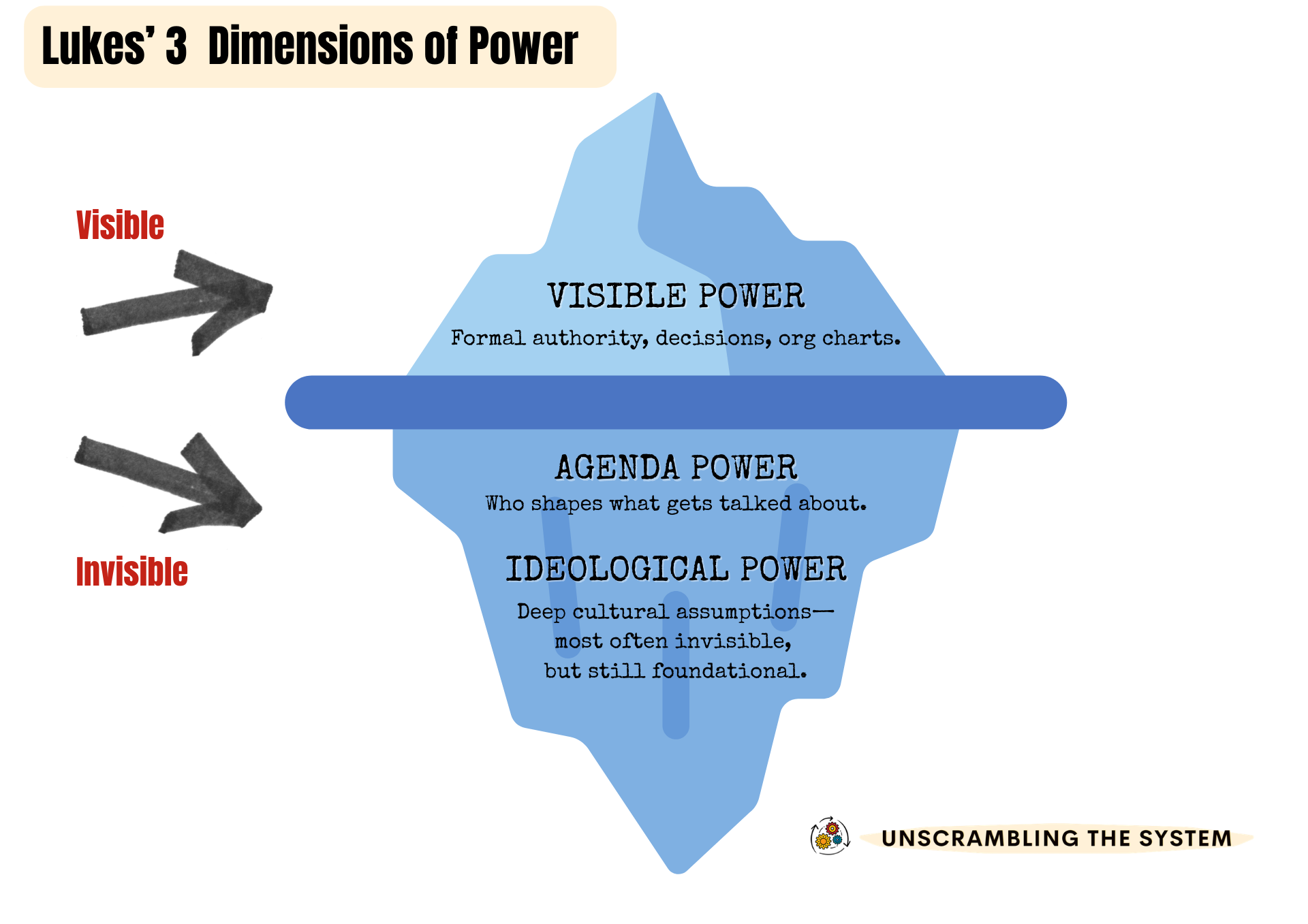
Different approaches have been used to illustrate this model graphically, such as a pyramid and concentric circles with visible power in the centre. However, I think the iceberg approach works really well in illustrating the power that is visible on the surface but invisible below. The power below the surface explains that feeling we may often have that there is something else at play than the official priorities.
The Three Faces of Power:
Visible Power (overt power)
This is the power we can see, such as who prevails in a formal decision or vote. Examples also include a budget signed off, a key leader appointed, or the approval of a new strategy.
Agenda Power (the mobilisation of bias)
Agenda power is about who decides what even makes it onto the table for discussion. For example, we may have a transformative proposal that could drive new business in new areas, but if we can’t get it on the agenda, it's not going to happen.
Ideological Power (deep cultural assumptions or unspoken norms)
Ideological power is even more subtle; it is about who shapes what people believe is possible, normal, or acceptable. For example, cultures that make disagreement feel like an action of disloyalty rather than constructive feedback, or status quo assumptions that are never allowed to be questioned. This can include non-discussion about business branding or mythologies about “what makes us successful”, even when there are better options that even higher management would like to hear if only the idea could reach up to them.
Power is often about outcomes, but this model shows that power is also about the battles that never get fought.
Why This Matters for Business
This is political theory that I am applying to the business world because it has a real practical use. Once you see it, you really can’t unsee it.
In today’s organisations, all three faces of power show up in strategic and subtle ways, for example:
Visible power is the visible structure of the system that sits with formal leadership such as executives, budget holders, and boards. This type of power is clear, necessary, and trackable, but it is also often reactive.
Agenda power lives with its gatekeepers that shapes system priorities. In the political world, this could be the chiefs of staff who decide who gets in to meet the president; it also includes respected insiders or the leaders of key projects such as dealing with a pandemic or a security issue. In the business world, they are the functional heads who shape the agenda inside their domains.
Ideological power involves the informal dynamics that move the system. It is embedded in the business culture, in the lingo and language that is used, and the mythologies of what the business is about, why it is the best or even why the world is in a better place because the business is there. But it is also why some companies can’t read the signals and pivot, even when the writing’s on the wall.
A stalled transformation effort can be a good example of how these invisible powers play out. On paper, everyone’s aligned on the new strategy. But behind the scenes, there may be middle managers who keep “raising concerns”, putting up roadblocks or encouraging disunity with the direction of change. In situations such as this, it is the faces of agenda and ideological power that are doing counterproductive work.
So in moments of disruption or internal conflict, this model is helpful in unscrambling why formal authority alone wasn’t enough to overcome the other two dimensions of power.
How Teams Can Adapt the Model
Knowing that there is more than one face to power helps business leaders to take more control of the situation to better align with the business priorities.
Here are some thoughts on how to begin to apply Luke’s model explicitly in a business environment. These are practical ways to rebalance influence. And they reflect a growing awareness that managing power really means managing systems.
Use stakeholder mapping tools to help track both formal and informal influence, that is to say who people listen to, trust, and follow.
Organise agenda-setting rituals such as reverse town halls or open-priority weeks to create space for ideas to surface from within rather than the usual centres of control.
Conduct culture audits; initiatives such as internal storytelling campaigns and norm-resetting activities help loosen the grip of ideological power, challenging what’s seen as acceptable or possible.
Power is Not Just Positional
In business, titles will still matter because good organisation needs a formal structure. But if we want to drive real change, we also need to see power as a system and read between the lines, to watch out for what’s not being said, to notice who’s shaping the agenda, and to constantly challenge the assumptions holding the system in place.
Last year, I made a short video about this topic on YouTube, which is available here: