The G20 Summit in Rio
What Just Happened. Edition 22 November 2024
The G20 Summit in Rio
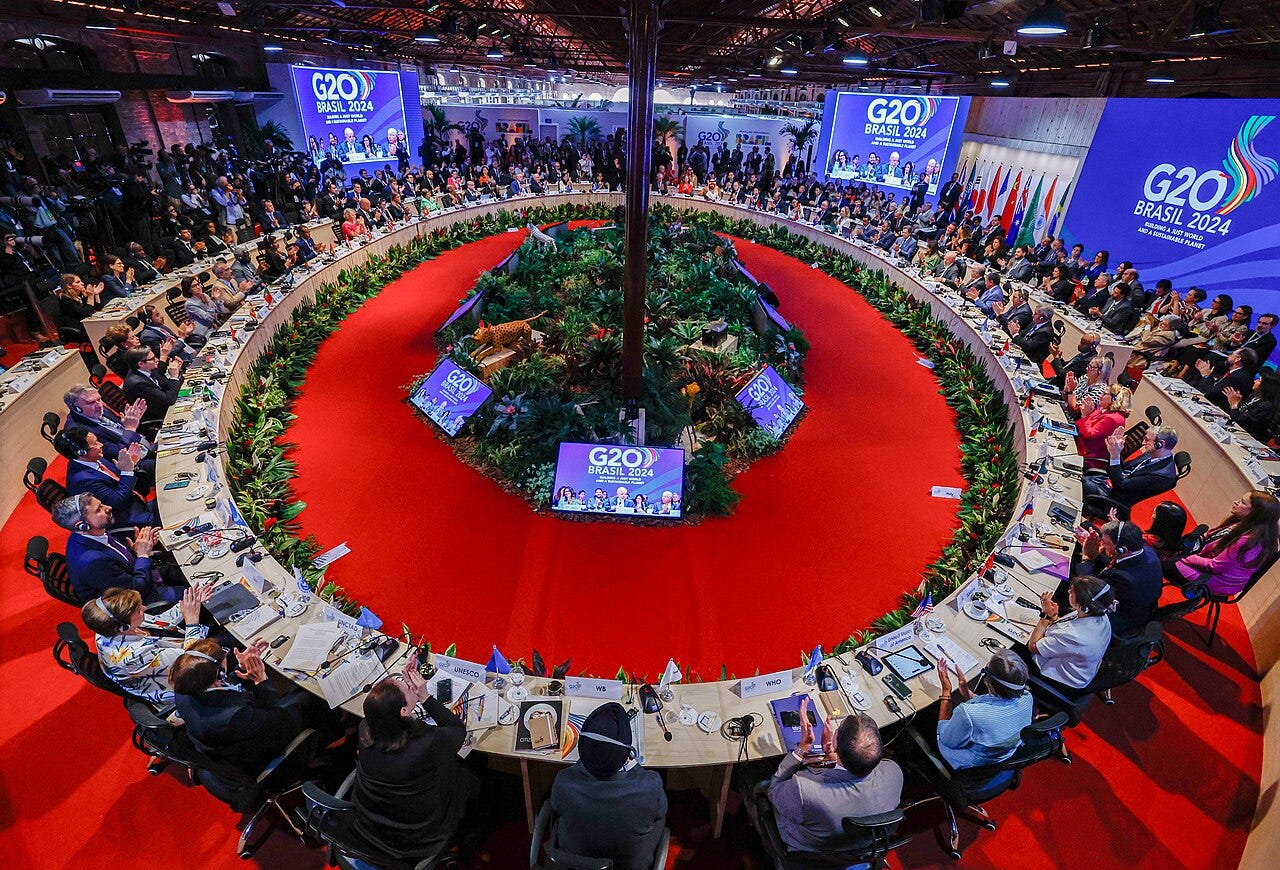
The biggest event in the international relations calendar this week was the 19th annual intergovernmental G20 Summit, held over two days in Rio de Janeiro, Brazil. It was the country’s first time to host such an event and only the second occasion when the summit has been held in South America. Brazil holds the presidency of the group this year and this week's summit represents the conclusion of its work as the holder of the rotating presidency.
The Group of Twenty (G20) brings together the 19 largest economies in the world plus the European Union and the recently admitted African Union. It is one of the most significant forums for international economic cooperation in the world as it includes all of the G7 countries and other significant economies such as China, India, South Korea, and Russia.
Among the priority discussion points on the agenda for the heads of state and governments arriving in Rio this week were the fight against hunger, poverty, and inequality, supporting sustainable development, and the reform of global governance. Climate change and the wars in Ukraine and the Middle East were also prominent topics of discussion.
U.S. President Joe Biden was in attendance this week. This summit may be the last major summit of his presidency after he decided not to run again for office earlier this year. However, minds were no doubt focused elsewhere. The summit took place in full knowledge that its biggest and most powerful member will be once again led by President-Elect Donald Trump who has made it clear he is more interested in prioritizing “America First” over international economic cooperation. The G20 Summit is due to be held during his presidency in the United States in 2026.
So what was agreed in Rio? After two days of discussions and debate a 22-page joint declaration was agreed upon amongst the parties. The key takeaway was an emphasis on international cooperation and multilateralism to solve global challenges from global hunger, climate change, migration, violent conflict, international trade and development, to global institutional reform.

The declaration indicates that the number of people facing hunger has increased, reaching about 733 million in 2023, with children and women being the most affected. At the summit this week in Rio, the Global Alliance against Hunger and Poverty was launched as an “innovative approach to mobilizing finance and knowledge sharing to support the implementation of country-led, country-owned, large-scale and evidence-based programs aiming at reducing hunger and poverty worldwide.” The initiative is committed to reversing recent setbacks in achieving the UN Sustainable Development Goals to eradicate hunger and poverty.
The declaration has also called for the implementation of the G20 2023 Action Plan on Accelerating Progress on the Sustainable Development Goals, a commitment to enhancing additional tools and mechanisms to fight inequalities, and a reaffirmation of the Paris Climate Agreement goals. Moreover, the joint declaration endorsed the Ministerial Declaration on International Tax Cooperation, and promised: “to engage cooperatively to ensure that ultra-high-net-worth individuals are effectively taxed.”
On the subject of migration, which is currently a big political issue in many of the G20 countries, there is a commitment to “recognize the importance of preventing irregular migration flows and the smuggling of migrants, as part of a comprehensive approach for safe, orderly and regular migration while responding to humanitarian needs and the root causes of displacement”
With ongoing violent conflicts in Ukraine and the Middle East continuing to attract global attention and cause disruption, the joint declaration underscored that “all states must refrain from the threat or use of force to seek territorial acquisition against the territorial integrity and sovereignty or political independence of any state.”
On the specific situation in the Middle East, the G20 declared:
“Affirming the Palestinian right to self-determination, we reiterate our unwavering commitment to the vision of the two-State solution where Israel and a Palestinian State live side by side in peace within secure and recognized borders, consistent with international law and relevant UN resolutions.”
On the War in Ukraine, the declaration was less specific:
“We welcome all relevant and constructive initiatives that support a comprehensive, just, and durable peace, upholding all the Purposes and Principles of the UN Charter for the promotion of peaceful, friendly, and good neighborly relations among nations.”
There was a strong emphasis on upholding the rules-based international order in terms of trade and the economy:
“to ensure a rules-based, non-discriminatory, fair, open, inclusive, equitable, sustainable and transparent multilateral trading system, with the WTO at its core.”
The G20 has reiterated their support this week for reform at the World Trade Organisation “to improve its functions” and the need for the realignment of quota shares at the International Monetary Fund “to better reflect members’ relative positions in the world economy while protecting the quota shares of the poorest members.” Moreover, the declaration underscores “the need for enhancing the representation and voice of developing countries in decision-making in MDBs”, Multilateral Development Banks.
Staying with the subject of reform, the world’s richest nations would also like to see reform take place within the United Nations. At the UN Security Council, the G20 would like to see it become “more representative, inclusive, efficient, effective, democratic and accountable, and more transparent to the whole of the UN membership". In particular, they have called for:
“…an enlarged Security Council composition that improves the representation of the underrepresented and unrepresented regions and groups, such as Africa, Asia-Pacific and Latin America and the Caribbean.”
They have also pledged to work towards strengthening the UN Economic and Social Council (ECOSOC) to better promote sustainable development and achieve the Sustainable Development goals. Furthermore, there is a commitment to work towards a UN that is more representative in terms of geography but also gender balance, the G20 will work towards “increasing the nomination of women for senior positions, including the Secretary-General.”
This G20 summit will be US President Joe Biden’s last before he hands over power to President-Elect Donald Trump in January.

Speaking at the summit this week he said:
As you know, this is my last G20 Summit. We’ve made progress together, but I urge you to keep going — and I’m sure you will, regardless of my urging or not.
This group…has within its power to usher in a new era of sustainable development, to go from billions to trillions in assistance to those who — most in need.
This all may sound lofty, but this group can lay the foundation to make that achievable.
To make that achievable, the G20 will need the support of the biggest member of the group, the United States. We will have to wait until next year to see what the incoming Trump administration will choose to do. Next year’s summit is in South Africa. We should know a lot more about the state of the international multilateral order and US support for it by then.


